



















Archive for the ‘Who’ Category

Squirrel

Tuesday, July 20th, 2010

Reid Miles, Solomon Ilori

This morning during an interview, I was asked, “Where do you find inspiration?” This is a common question, and I understand the curiosity, but it’s complicated. Like every other creative person, I’m inspired by a million tiny details every day. I know the correct answer is, “Well, I just can’t get enough of Alvin Lustig.” That doesn’t work for me. Not that I don’t love Lustig, but there are too many other influences daily.

My mind works much like the dog in Up. I’ll be choosing blue Pantone colors and then, “Squirrel,” I’m doing something else. Today while looking at blue PMS chips, I thought, “Blue Note,” and found myself reading the Blue Note Album Cover Art book. I’d forgotten how truly incredible every cover is. Reid Miles was the in-house designer at Blue Note and designed most of the covers. From 1955 to 1967, he combined minimal abstract forms with an intense color sensibility. While Miles is often associated with Bauhaus rigor, his covers are more closely related to Color Field and Minimalist artists such as Ellsworth Kelly. I often tell people that “cool” is a terrible trap leading to desperate work and endless suffering. I admit, however, that Miles’ covers are cool—the good kind of cool.

The Invention of Flirting in America

Monday, July 19th, 2010

not Cicely, but another relative, Lady Susannah Beverley Randolph

The women on my mother’s side of the family have always been attractive. This comes with a price (sanity). There is a long-standing tradition that a distant grandmother brought flirting to the New World. As it turns out, this story was correct. Cecily Reynolds came to Jamestown in 1610 aboard the Swan. Her uncle Captain William Pierce, with his wife Joan, served as chaperon on her voyage. At the age of 14, Cicely married Thomas Bailey. Unfortunately he soon dropped dead from malaria. She then quickly married Samuel Jordan.

The Jordans neighbors were John Rolfe, who had married Matoaka Pocahontas Powhatan. After her death, Rolfe married Capt. William Pierce’s daughter, Jane Pierce.

Cicely survived the Jamestown Massacre in 1622 by, as the story goes, standing firmly at her front door and refusing to move. The Powhatan Indians were impressed with her fortitude and beauty and let her live. That story seems a little far-fetched, but who knows? Soon after the Massacre, Samuel Jordan dropped dead, too. Now, this may seem too coincidental. One husband after another dies suddenly. Marrying Cicely may have seemed like a death sentence. But, in Jamestown death was common.

Within three or four days of Samuel Jordan’s death, Cicely agreed to become the wife of Rev. Greville Pooley. She was pregnant with Samuel Jordan’s child, so she asked that the engagement be kept secret. However, Rev. Pooley was so impressed that he had won Cicely’s hand that he spread the word. Not a good move, now a furious Cicely refused to go through with the wedding. Rev. Pooley sought to hold her to her promise. William Farrar, the administrator of her late husband’s estate defended her, causing the first breach of promise suit in America. Farrar then became husband three.

They were married for 10 years, and then in 1634, Farrar, surprisingly, died too.

Cicely Reynolds Bailey Jordan Farrar then married my distant grandfather, Peter Montague. Peter came to Jamestown in 1621 aboard the “Charles” at the age of 18. Peter and Cicely had seven children including Mary Montague, George Washington’s grandmother. This marriage lasted for 25 years until Peter Montague died in 1660.

Finally, at 59, Cicely Reynolds Bailey Jordan Farrar Montague married husband five, Thomas Parker. There were no children from this marriage, and Parker died three years later. Unfortunately, as was the case with many women, after this we lose records on Cicely. As a member of my mother’s family, I can surmise that, at this point, she had thick wavy white hair, a wry and dark sense of humor, and perfect grace.

1957 Jamestown Festival booklet

1622 Jamestown Massacre

The first Thanksgiving, Jametsown, yes, that's right

Jordan's Journey marker

Peter Montague grave

C’est le ton qui fait la musique

Wednesday, July 14th, 2010

In honor of Bastille Day, I am posting scenes from the incredible film, Playtime, directed by Jacques Tati. Tati’s Monsieur Hulot films have a running theme of cold modernism and urbanity interrupted by human nature. I’ve never particularly understood the Playtime’s plot. It’s in French, so that’s an issue for me. But, nothing seems to happen. Monsieur Hulot is put in a series of funny situations and the sets are wonderful. I know they are supposed to be cold and sterile. They represent the decay of true non-conformity and human creativity. I, however, love them. So much glass, steel, and modern devices can only be good for people.

Seduction and Symbols

Thursday, July 8th, 2010

Norman Rockwell, The Problem We All Live With

It’s not considered hip to like Norman Rockwell. But, fortunately, I gave up on the hip idea a long time ago (hence the madras shirts and khakis I wear). Last term, I suggested that one of my students look at the Norman Rockwell Four Freedoms. I was met with a blank stare, as if I’d suggested researching an obscure 14th century painter. This was a terrifying moment. People’s grandmothers like Norman Rockwell. I assumed everyone in the civilized world knew at least a few paintings. I was wrong, and that is the tragedy of today’s wayward youth. They all need a good dose of Rockwell’s wholesome small town. That would keep them away from the constant huffing.

Obviously, this world is a mythical place sort of like Pleasantville. Rockwell’s paintings go beyond the sentimental. They carry symbols and iconography that allow us to manufacture a clear narrative. It is not just a picture of the teacher’s birthday. The scene is set with a multitude of clues. The coat in her hand and chalk eraser on the floor communicates her surprise. A line of small gifts is on her desk. Each of these tells a story of the children preparing for this day at home, or on the walk to school. Even the tiny section of the American flag sets the scene in a minimal way.

The Problem We All Live With, painted in 1964, depicts Ruby Bridges walking to the newly integrated Frantz Elementary School in New Orleans. It is the most requested piece at the Norman Rockwell Museum. This incredible painting succeeds with the use of a tool I often discuss, seduction. The unassuming and innocent approach welcomes the viewer into the piece, and then communicates a complicated and disturbing subject matter. The racial slurs on the wall, and thrown tomato contrast with the girl’s white dress and confident stride. The touch of a notebook with stars and the red and blue pencils suggests the American flag subtly. This is not sentimental, or purely journalistic. Rockwell was a genius at utilizing symbols, color, and scene to convey a narrative in a single moment.

Norman Rockwell, New Day in the Neighborhood

Norman Rockwell, Teacher's Birthday

Norman Rockwell, The Connoisseur

Norman Rockwell, Freedom from Want

Norman Rockwell, Sunday Morning

Grandpappy Walker

Thursday, July 1st, 2010

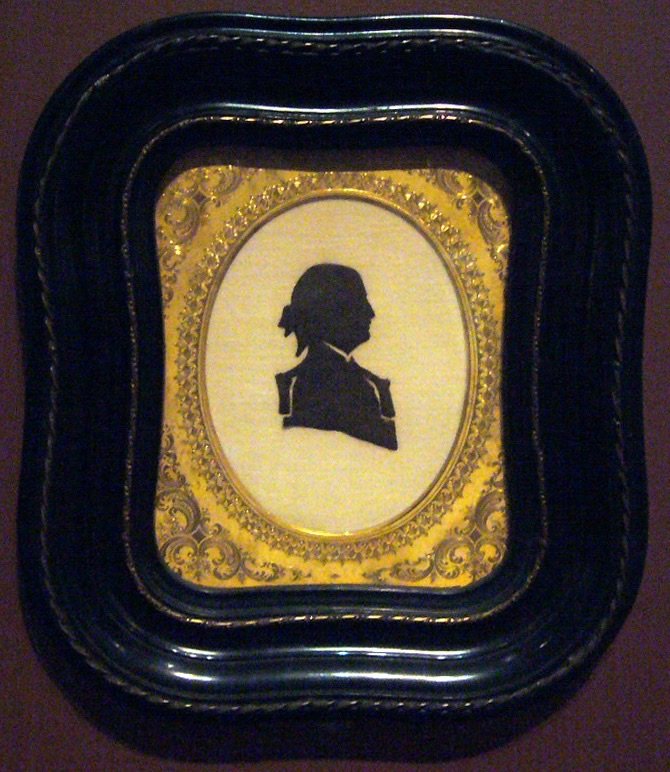
The only surviving image of Dr. Thomas Walker, Virginia Historical Society

Since it’s almost Independence Day, I decided to post about someone in my family who was involved with the revolution. Sure, there are the likely suspects: George Washington, John Adams, and Thomas Jefferson. And, they are indeed family members on either my mother of father’s side. But we all know those stories. One of my favorite distant grandfathers wasn’t as well known as the these others. Dr. Thomas Walker was born in 1715. He was Thomas Jefferson’s guardian, the first white man to explore Kentucky, and did a whole batch of impressive things.

But I like him because he risked everything for the revolution. By 1776, Dr. Walker was 61 years old and one of the wealthiest men in Virginia. He wasn’t a destitute revolutionary; he was firmly set as a member of the gentry. It would be as if a comfortable CEO of a Fortune 500 company decided to join a revolution today. Typically comfortable old white guys don’t do this. There is also an old family tale that is probably stretched, but who knows.

In 1781, British Colonel Banastre Tarleton marched on Charlottesville with the intent to capture then Governor, Thomas Jefferson. When the British Army reached the family estate, Castle Hill, my distant grandmother and Dr. Walker delayed them by preparing a fine breakfast. Legend has it they also supplied liquor. This gave the patriot Jack Jouett time to warn Governor Thomas Jefferson and the Virginia legislators of Tarleton’s plan to capture them, and they escaped.

Just after the American Revolution, a traveling author visited Castle Hill and wrote an account of his interview with Dr. Thomas Walker:

“One day, in a chat, while each was delivering his sentiments of what would be the state of America a century hence, the old man [Walker], with great fire and spirit, declared his opinion that, ‘The Americans would then reverence the resolution of their forefathers, and would eagerly impress an adequate idea of the sacred value of freedom in the minds of their children, that if, in any future ages they should be again called forth to revenge public injuries, to secure that freedom, they should adopt the same measures that secured it to their brave ancestors.’”

Thomas Anbury (Travels Through the Interior Parts of America, 1776-1781)

Castle Hill, Virginia